

What Does the R-Value of a Sleeping Mat Mean?
The R value indicates how well a sleeping pad resists the transfer of heat from your body to a cold surface. As the number increases, the pad’s insulation improves. In essence, a high R value means there’s a stronger thermal barrier between the pad and the ground.
This is not a temperature reading. You cannot simply say “used up to this degree” for a mat with an R value of 4. Temperature is influenced by factors such as the humidity of the ground, the sleeping bag you are using, your clothing, and your sensitivity to cold.
For me, the R value is a very important selection criterion. When buying a camping mat, I don’t just pay attention to the number on the packaging, but also to which standard that number was tested according to. I tend to trust companies that provide such detailed information and clearly share their test results. My opinion is that companies that demonstrate this level of attention generally have better material and workmanship quality, which increases the likelihood of the product lasting a long time.
Of course, a single high ‘R’ value is not a guarantee of durability. However, testing and transparency are among the most useful indicators when making a purchase.
What is the R value?
The sleeping bag and the mat have different functions. The sleeping bag tries to maintain the warmth surrounding your body. However, the filling beneath the bag is compressed by your body weight, and loses a significant portion of its insulation.
At this point, the camping mat comes into play. The mat’s function isn’t simply to minimize the feeling of the stones and roots; it’s also to provide insulation against the cold ground.
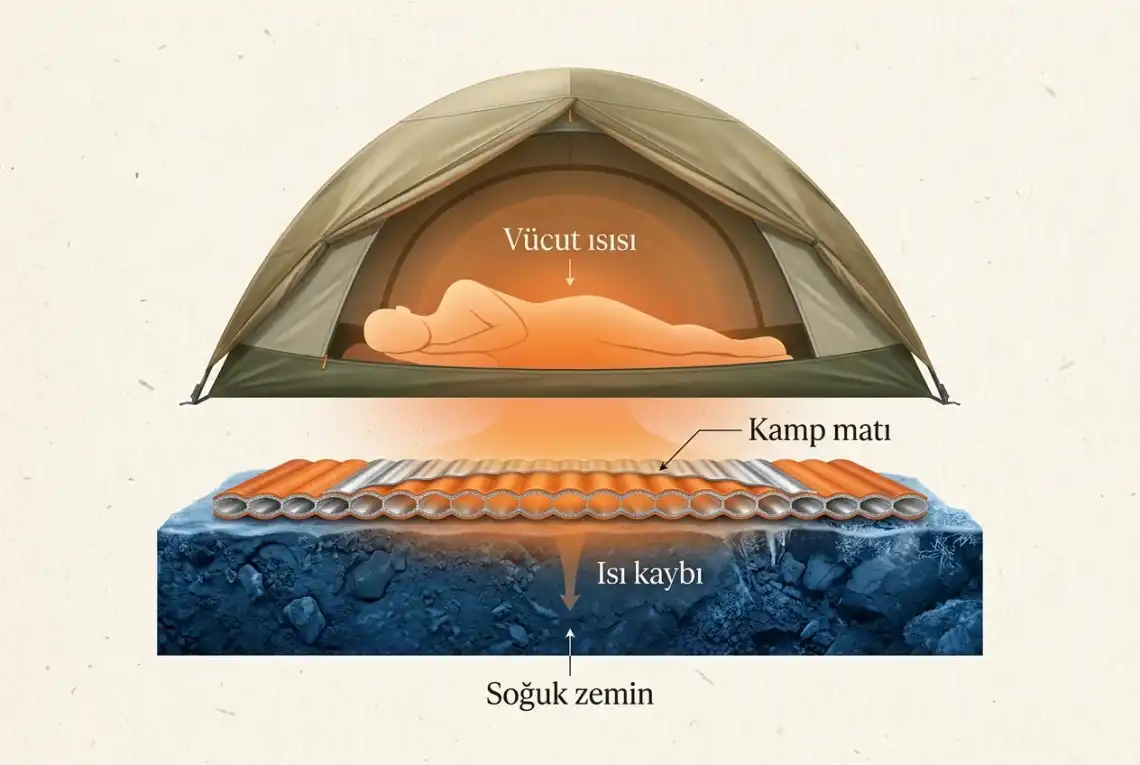
This is a system that works with a sleeping bag and a camping mat; it reduces heat loss from the mat surface.
If your thermal suit seems to have adequate warmth, but you feel cold on your back and hips, the problem might be with the layers underneath the suit. Adding an extra layer on top might help, but if you’re still feeling cold and have lost heat from below, the issue remains with the base layer.
Does a high R value mat make it warmer?
The mat itself isn’t inherently warm. It gets warm depending on the temperature of the surrounding environment; when you lie on it, your body heat begins to warm it.
A high-R value mat helps to limit the escape of this heat to the ground. Therefore, you might feel like “the mat is warming me,” but its function is not to produce heat, but to reduce heat loss.
Write a high R-value mat; don’t assume it will necessarily be uncomfortable. It doesn’t function like a mat heater. However, models offering higher insulation often tend to be heavier, bulkier, or more expensive. When choosing a mat for a summer camp, it’s important to consider not just the R value, but also factors like weight, package volume, comfort, and durability.
What should the Mat R value be?
This question doesn’t have a single, universal number that applies to everyone. When planning your camping trip, you should consider the season in which you’ll be camping, as well as the ground you’ll be camping on. A dry summer camping trip and a wet, muddy ground, or a high-altitude meadow, or camping on snow, all require different conditions.
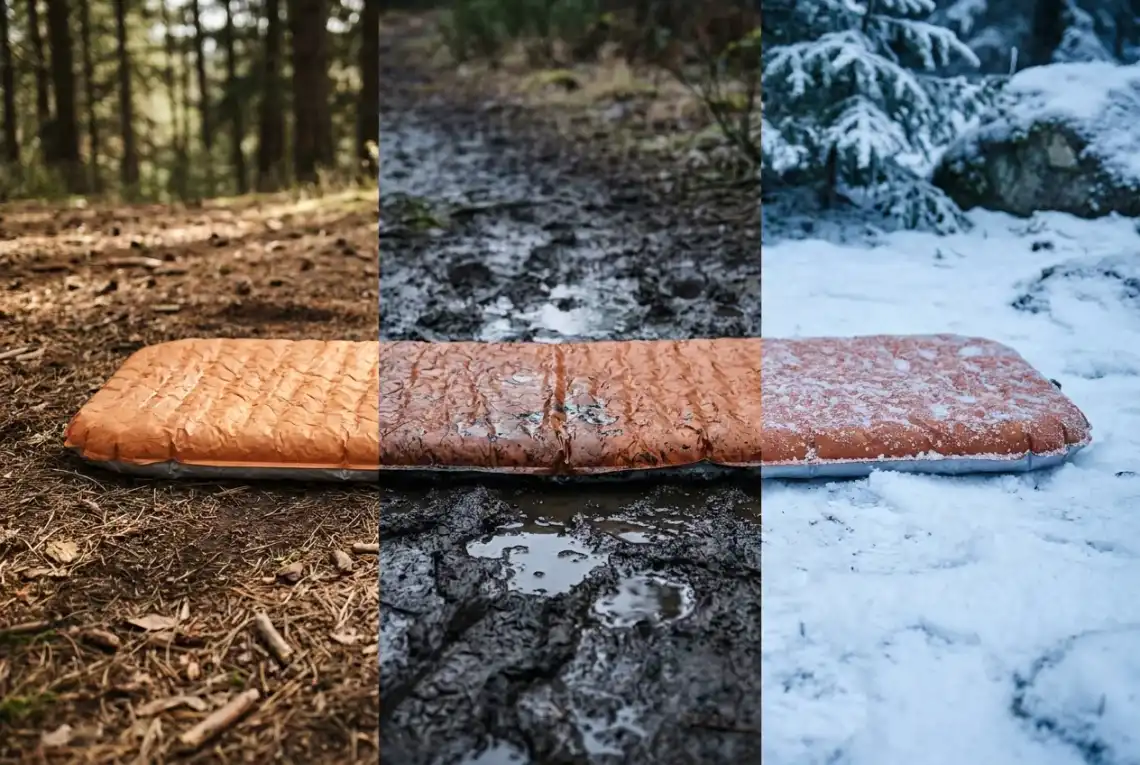
It may not provide the same level of comfort on the same mat-like, moist soil, or on ice.
When making your choice, you can use the following order:
- Investigate the lowest nighttime temperature you can expect at your camping location.
- Be sure to consider the possibility that the soil is wet, frozen, or covered in snow.
- Evaluate the comfort level of the sleeping bag you are using.
- Don’t forget your personal sensitivity to the cold.
- Please check the manufacturer’s usage instructions and testing methods.
- Leave a reasonable safety margin in place of a value that remains on the border.
Reading the R value on its own, like a seasonal label, can be misleading. The same “three seasons” phrase can represent different conditions in various brands and in different geographical locations. It’s more reliable to evaluate the number in conjunction with the usage conditions.
If two matrices are used one on top of the other, do the R values get added together?
Yes. When you use two mats together, their insulation ratings roughly add up. Put a foam mat with an R-value of 2 under an inflatable mat with an R-value of 3, for example, and you get a sleeping surface rated around R 5.

The foam mat beneath the inflatable mat provides both insulation and additional protection against the ground.
This method is particularly useful for strengthening the existing system in cold weather. The foam mat below can also protect the inflatable mat from sharp rocks and small irregularities in the ground.
However, do not consider this process as accurate as a laboratory result. The way the mats settle, shift, and experience pressure, as well as movement throughout the night, can affect the actual performance.
How is the R value tested?
For camping mats, the current and comparable testing method is ASTM F3340-22. During testing, the mat is placed between two hot and cold plates with a specific pressure. The energy transferred from the hot side to the cold side is measured, and the mat’s resistance to heat transfer is calculated.
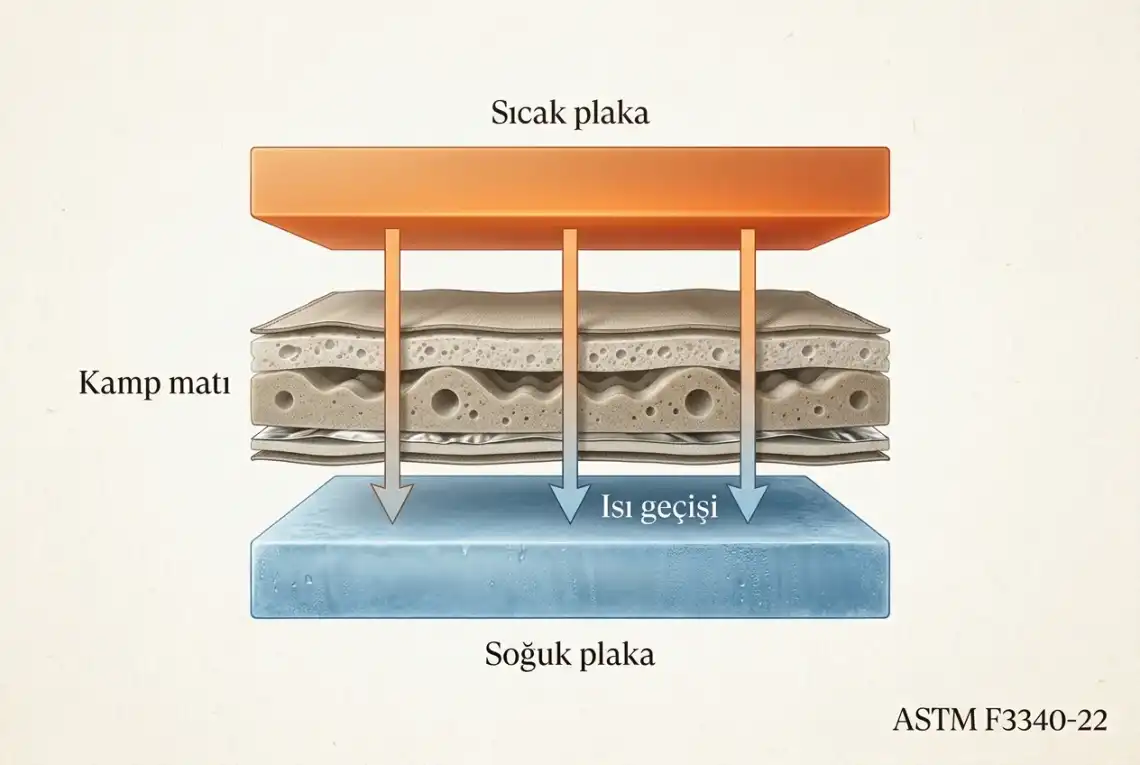
The standard laboratory test compares mats by measuring heat transferred from a hot side to a cold side.
There’s some laboratory work coming up, actually. But, from a user’s perspective, the benefit is quite simple: you can compare the R values of two fabrics being tested using the same method in a much more meaningful way.
Let’s address a specific point here. The standard used for the R value of camping mats is ASTM F3340. ISO 23537-1:2022, on the other hand, concerns the temperature performance, dimensions, and labeling of adult sleeping bags. Therefore, when setting up a good sleep system, it’s more accurate to look for the ASTM test on the mat and the ISO temperature values on the sleeping bag.
Will the laboratory results be exactly replicated in the actual scene?
No. The standard test provides a repeatable comparison; however, it does not guarantee the night you will experience in the field.
The most crucial details that can change the outcome in real use are:
- Wet or damp ground can transfer heat faster than dry ground.
- The movement of air within the inflatable mat can increase heat loss.
- The text may not be balanced enough, which could lead to some areas of the body sinking more than others.
- Your sleeping position and movement throughout the night alter the distribution of pressure.
- There may be additional heat loss from the sides and exposed areas.
- The sleep sack, clothing, fatigue, and personal metabolic sensations will all affect the comfort you experience.
Therefore, when checking the inflatable mat in the store, don’t just see if it’s soft. Also, check how stable it is when you lie on it and turn left and right. A mat that looks good on paper might not perform as well at night if it’s constantly undulating like a small sea bed each time you turn.
Is the R value truly tested, and how can it be determined?
On the product page, simply seeing a large “R” is not enough. Look for the following information:
- It is clearly stated that the R value is measured according to the
ASTM F3340standard? - Has it been specified whether it was produced by a testing manufacturer or an independent laboratory?
- Does it provide clear information about the brand test method and its results?
- If the values for the same model change in different thicknesses and sizes, are these changes described separately?
- Is the product’s weight, fabric, repair possibilities, and warranty conditions also clearly stated?
Some products may only display an estimated or manufacturer-stated number instead of “test edilmiş R value.” It is not advisable to directly compare such a value with another product measured according to ASTM standards.
I pay close attention to brands that provide detailed technical information. If a company clearly explains the limits, testing, and maintenance of its products, not only do they craft a nice marketing phrase, but they also demonstrate how well they understand what they do.
Is it sufficient to only look at the R value when choosing a camping mat?
No. R value is a strong measure for comparing insulation performance, but it does not describe the entire text.
When considering a good camping mat, take the following into account:
- The R value suitable for the condition you will use, tested R value.
- The appropriate thickness and width for your sleeping position.
- The structure remains balanced while rotating on top.
- The weight and package volume you can carry
- The fabric’s durability
- The area is repairable.
- Valf and sewing quality
- Warranty and spare parts support
No matter how good the mat is, if the sleeping bag is inadequate, it won’t provide a comfortable night’s sleep. Similarly, even a very good sleeping bag cannot completely cover the gap in the mat, which is weak against the ground. It’s important to consider these two as a single sleep system.
For the other half of your sleep system, see how to use a sleeping bag. If you need a new bag, read what to look for when buying a sleeping bag.
What should be remembered regarding the R value?
Here’s a brief summary:
- As the R value increases, the text’s insulation against the ground becomes stronger.
- R value is not a direct temperature measurement.
- Search for ASTM F3340 standard for comparative testing on camp mats.
- The ISO temperature test performed on sleep sacks is not the same as the ASTM R value for the fabric.
- When the R values of two texts are used together, they can be approximately combined.
- The laboratory value is important, but factors such as moisture, soil, and the balance of the mat, as well as personal conditions, ultimately determine the real result.
- Evaluate R value considering comfort, weight, durability, and repairability.
For me, good equipment isn’t just equipment that looks good. It’s equipment that has been tested and measured for its values, that honestly describes its limits, and that has been carefully produced to last for many years.
Could you please share the fabric’s brand and model, the D value, nighttime temperature, and ground conditions in the comments? This way, people researching the same fabric can not only see the number on the label, but also the actual experience of using it.
What did you think of this article?
Be the first to react.
Loading…
Discussion
Comments
Tell me what you think of this article. Use the button below to open the comments.
Related posts